Just a short mile north of Kingswinford, along the path of the old Anglo- Saxon road from Worcester to Stafford, lies a large brownstone manor house set back from the main road – its windows now boarded up in steel and the site deserted.
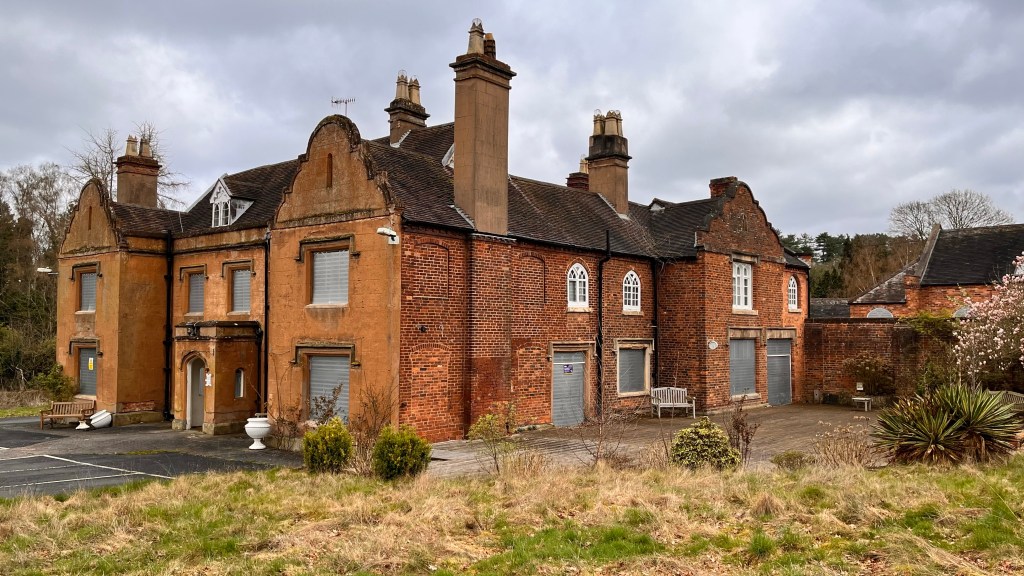
Holbeche House is infamous as the place where the last bloody stand of the Gunpowder Plotters took place in 1605, in what was then Staffordshire – now a far edge of the West Midlands.
The house has lain empty following the closure last year of the care home that once occupied the site.

Holbeche (sometimes spelt Holbeach or Holbeache) was Grade II* listed by English Heritage in 1951, the second highest possible, signifying it as a building of, ‘more than special interest.’
Thankfully of course, as a result of the listing, the building cannot be demolished or altered without the consent of the local planning authority – in this case, Dudley Metropolitan Borough Council.
Presumably, the privately owned house is to be put up for sale but it’s a concern to see a building with such an important story left deserted.
The Historic England entry for Holbeche dates the north-east corner of the present house to the 16th century. The remainder of the house was said to be built circa 1710.
The 1951 English Heritage listing states that there is, “original fabric internally, including good panelling to the ground storey room” and that the building had two priest holes.
With the house currently lying empty this would seem such a great opportunity for architectural historians to undertake a survey of the building as its unclear when the house, once owned by the Earl of Dudley, was last inspected as part of a heritage field assessment.
Sadly, the house was also not apparently surveyed as part of Nikolaus Pevsner’s landmark architectural survey of England. Pevsner’s 1974 Staffordshire edition, refers to the house only in passing as, “indeed an early seventeenth century building.”
“We mean here to die” – Holbeche House and the Gunpowder Plot
At the time of the Gunpowder Plot in 1605, Holbeche was owned by Stephen Lyttelton (sometimes spelt Littleton), a prominent member of local Midlands Catholic society at that time.
Holbeche was described by local historian D.R. Guttery, as being well known in the area as, “the house in the dip that Swinford folk steal to hear the forbidden Mass whenever some courageous priest will risk his life to come there to say it.” The house’s secret priest holes are testament to this fact.
The parliamentary terror plot, famously foiled following an anonymous tip off, was essentially a Midlands conspiracy, one which had sought to topple the Protestant King James I and restore a Catholic ( Lady Elizabeth, one of James’ younger children) to the throne.
The group of plotters had fled to the house on the evening of 7 November. Mild chaos appears to have ensued. Some of the group’s gunpowder had got wet whilst the gang were crossing the River Stour at Amblecote, this had then be laid out in front of an open fire to dry. Rather unsurprisingly it was ignited by a stray spark, causing a much larger bag of gunpowder to be jettisoned through the roof of the house, landing outside in Holbeche’s courtyard.
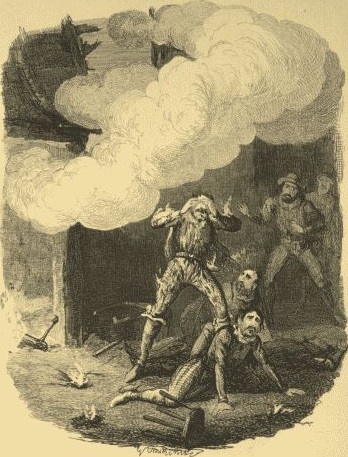
This explosion injured Robert Catesby, the plot’s mastermind and led to further desertions from the band of rebels, some of whom thought that the explosion was divine intervention.
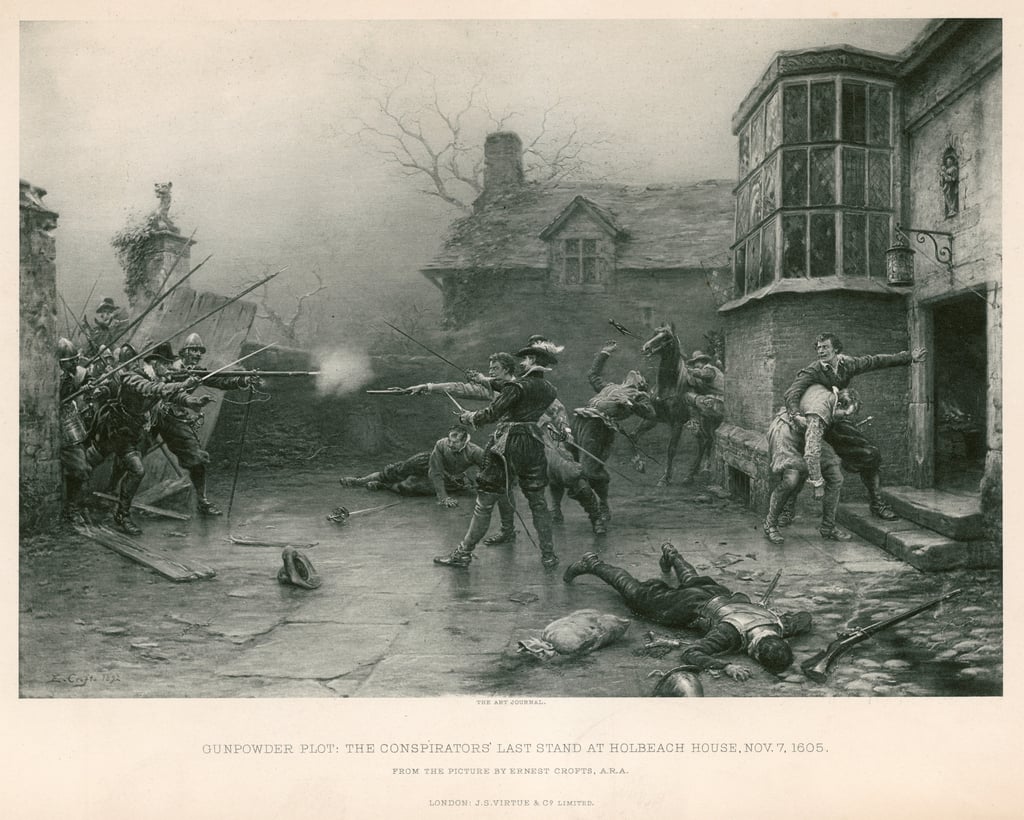
Local militia led by the Sheriff of Worcestershire caught up with the last of the “rebellious persons” at Holbeche on the morning of 8 November. The militia included some of the Sheriff of Staffordshire’s men – after all, this was border country.
In the bloody siege that ensued, arch plotter Robert Catesby and fellow gang member Thomas Percy were caught with a single musket shot. Catesby died instantly, though Percy survived for a few days.
Two other plotters, John and Christopher Wright also perished in the siege, that led to squabbles between the competing militias. Arguments apparently ensued about who was taking who as prisoner, who grabbed who first, apparently leading to a scuffle between the different forces in a local alehouse.
There was even an argument over who should get Wintour’s gilt copper spurs.
Eventually, it was settled and the two plotters that survived – Wintour and Rookwood – were carted off to Worcester Town Hall to meet their trial and an eventual ghastly fate.
Holbeche’s owner Lyttelton had managed to flee Holbeche before the siege famously trying to warn Thomas Wintour to avoid the house. In his confession, Wintour explained he had insisted on travelling on to Holbeche to speak to Catesby and the remaining plotters who confirmed to him that they would not flee and, “we mean here to die.”
Lyttelton hid in various locations in Worcestershire for 8 weeks, staying with sympathetic friends in Wordsley, Rowley Village and at his Uncle Humphrey Lyttelton’s Hagley Hall. He was eventually caught in January 1606 after being betrayed by a member of the hall’s household staff.
Both Stephen and Humphrey were to be eventually executed for their connections to what is the most infamous terror plot hatched on English soil.
As for the house, let us hope that it will prevail and its legacy can be preserved – such a key part of West Midlands history, tales made and told, long before the industrial heritage rose up around us.
UPDATE: Holbeche House was added to the English Heritage Buildings at Risk register in November 2023. A very welcome development. Dudley Council are also now actively engaged with the owners in seeking a future for this special building.
Sources:
The Gunpowder Plot: Terror in Shakespeare’s England – James Travers (National Archives – Amberley Publishing ) 2019
From Domesday to Doomsday – DR Guttery (Brierley Hill Public Libraries) 1947
Staffordshire: The Buildings of England – Nikolaus Pevsner (Penguin) 1974
The Victoria History of the Counties of England – A History of Staffordshire Volume 1
Historic England website
 Tales from the Halfshire Hundred
It is so sad to see this lovely old home-in which my husband lived for several years.Th;e Pitt family were owners in the mid 20 century where it was lived in in splendour.It did require quite a big staff to keep it up to scratch. A memorable house with such an interesting history.
It had a substantial vegetable garden, grass tennis court and swimming pool-filled from a deep well.
LikeLiked by 1 person
I agree. I am a descendent of one of the Wright Brothers, not sure whether it was Kit or Jack though and it is heartbreaking to see if so abandoned.
LikeLiked by 1 person
Who owns Holbeche House, Kingswinford?
LikeLike
Hi – it was owned by a private company who ran it as a care home. I presume it’s still owned by the same company.
LikeLike