By Lisa R Marshall
Back in 1998, the BBC broadcast a documentary series , ‘Travels with Pevsner.’ This series followed a number of different writers as they revisited landmark buildings in some of our old English counties, celebrating that great work of academic scholarship, the vast 46 volumed, ‘The Buildings of England (1951-1974),’ by Nikolaus Pevsner. Guides famously designed to catalogue every notable building in England.
The writer, critic, essayist and film maker Jonathan Meades presented one of the episodes – an episode that was to take up residence in my head (a link to this episode is included below.)
I found it simply unforgettable. Why? Well, three things.
Meades chose a shared love – Worcestershire – the county he would write later was, “west of the Severn, the loveliest part of England.” Secondly, it’s Meades, and finally, because it so memorably evoked the English poet, A.E. Housman more famously, of course, associated with another beautiful Midlands county.
I certainly agree with Meades on Worcestershire.
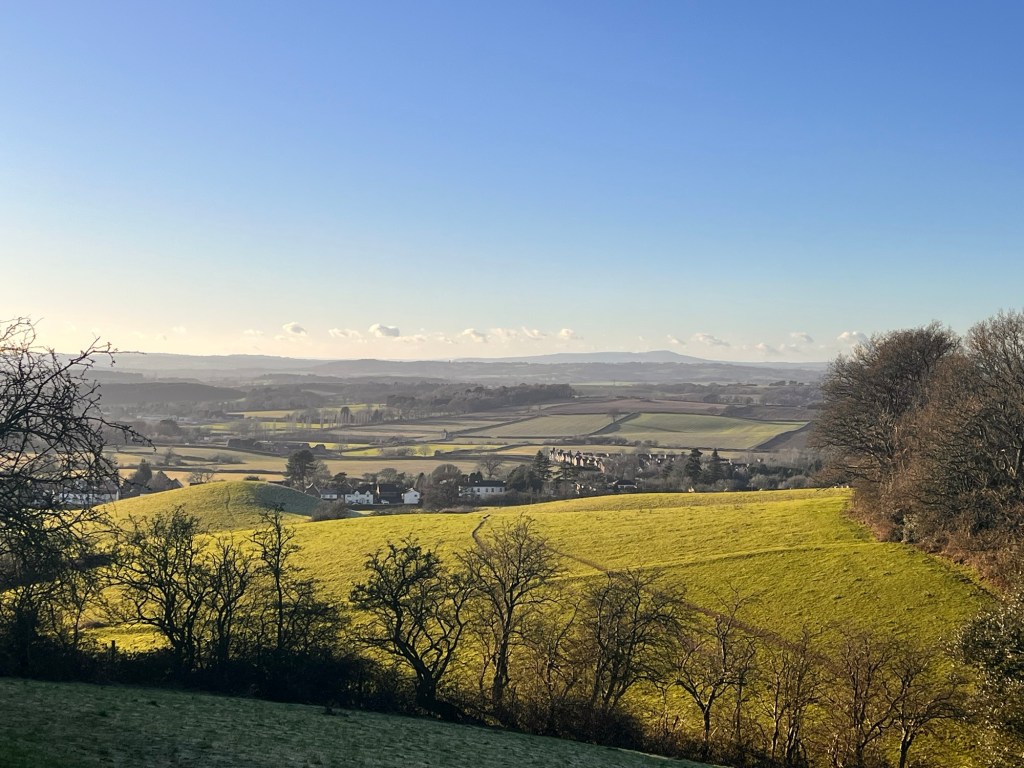
There is indeed some simple ‘loveliness’ about Worcestershire as a county, lying as it does,”in Severn stream”, that grandstanding tidal river that carves through it in wide fast flowing stretches.
Personally, I love it for its quiet, unassuming ancient wooded lanes, easy vales, fields pockmarked with old battlefields and pear trees, for its odd follies, its old tales. Perhaps, mostly because of it’s seclusion – the Cotswolds, it is not.
The Worcestershire programme launches with Meades, besuited and sunglassed up as per, ‘flying ‘ up country to the Vale of Evesham and beyond, transported Peter Pan style back to childhood years spent roaming the county, guided by his Uncles Hank and Wangle.
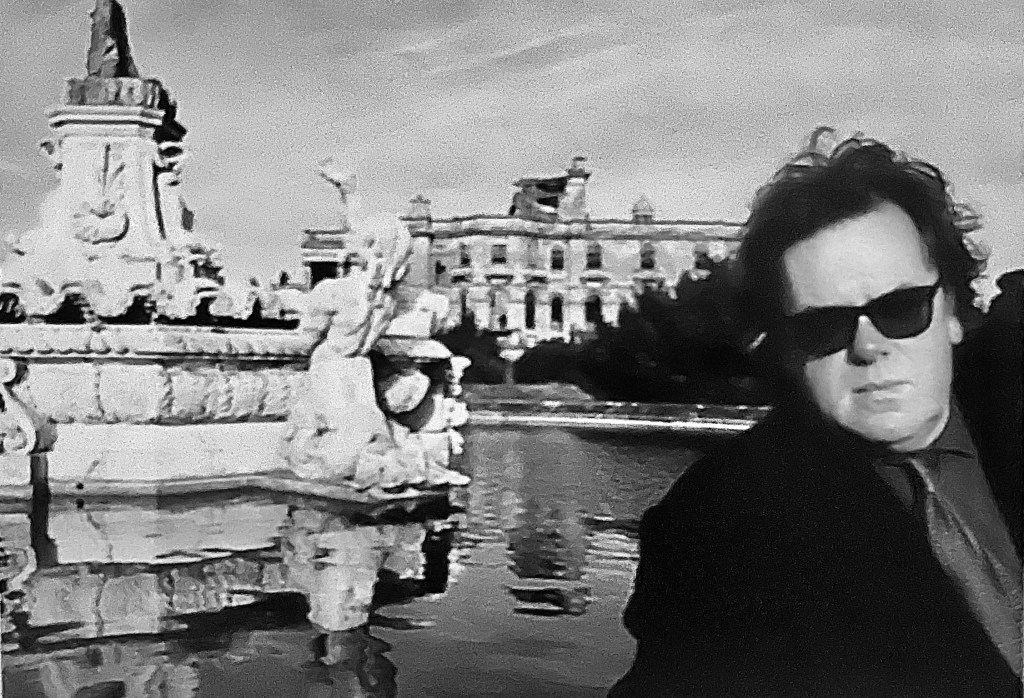
Though born in Wiltshire, Worcestershire holds Meades firmly in a Severn soaked grasp. The county runs deep in his blood, his father was a native of Evesham, his grandfather was from Oldbury, (originally a detached part of Shropshire, then becoming part of Worcestershire, before the newly formed West Midlands county hoovered up along the old county lines, drawing in the ‘last homely house’ along its new edges in 1974.)
Meades proceeds in classic style – sharp, intelligent, irreverent, darkly humorous, often scathing – as he tours key historic sites of the county as mentioned (or omitted) in Pevsner’s Worcestershire volume, first published in 1968.
Meades is a self-confessed addict of these meticulously detailed architectural guides, which he believes stand for, “a certain type of Englishness” and are, “a gift to this country” by Pevsner, that sparklingly brilliant German Jewish academic who fled the Nazis in 1933 and who would go on to be knighted in 1969 for services to art and architecture. Like Meades, Pevsner also doesn’t mince his words – if he thinks a building vulgar, he will tell you straight.

During the journey of the episode, Meades’ visits a starry list of Worcestershire’s greatest sights – Madresfield Court, that of Evelyn Waugh and the Brideshead Revisited connection, Pershore Abbey, Worcester Cathedral, Hanbury Hall, Broadway Tower, Chateau Impney, Croome, Witley Court and others. He also finds good opportunity to attack a couple of his pet hates, the National Trust and English Heritage, the former of which he says, “embalms buildings.”
However, its not just buildings that Meades focusses on. He also takes the opportunity to reflect on the beautiful Worcestershire sites, views and hills much loved and idolised by his Uncles – places like Bredon Hill and the Malverns, and it’s here he evokes Worcestershire-born AE Housman and more specifically that sublime work , ‘A Shropshire Lad.’
Housman had been born in Fockbury, near Bromsgrove in 1859. For Meades, it’s as if Housman’s “morbid magic” hangs over these lands with simple verses that haunt the old paths and byways, cross shire lines and lead to the long views North, to the distant Shropshire hills that Housman would have gazed on.
Although I knew Housman had never lived in Shropshire, I was still strangely surprised to learn he had actually written the work in London and a part of London I know well.
Along the busy main road that runs north out of Highgate into Haringey, you will find a row of pretty red bricked cottages set back from the road. The first is Grade II listed, ‘Byron Cottage’, built in the early eighteenth century and once home to Housman when he lived in this corner of North West London.

Byron Cottage, Highgate by Lisa Marshall
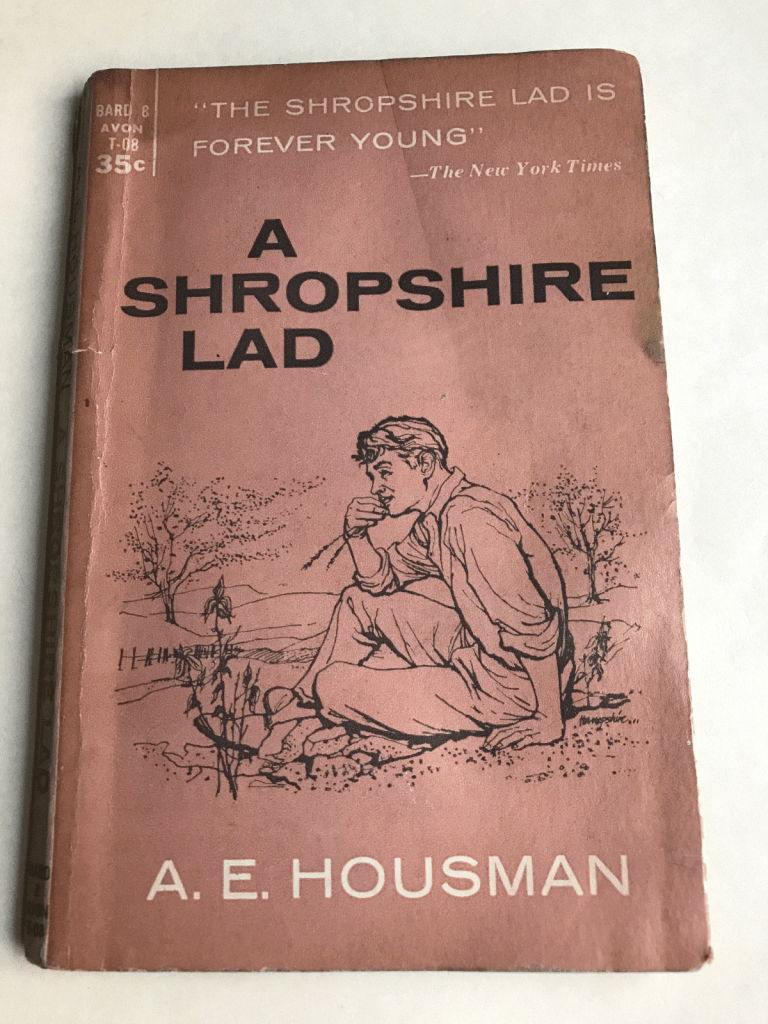
It was here in London in 1895, that he wrote the vast majority of the 63 poems that were to become, ‘A Shropshire Lad.’
Although, slow to catch interest following its initial publication in 1896, by the time of the First World War, soldiers were said to be tucking copies of it into the breast pockets of their uniforms. Perhaps, in the hope the words would provide solace or at least help shroud them in fresh English leaves and the green grass of home.
Those old shire memories of hills and the Severn must have been mired in a great fog of distance for Housman walking in Highgate, staring down at the creeping expanse of London’s vast smoke. Perhaps it was this distance though that fuelled the longing, charged the clarity, the force of the poetry and the projection of memory, what Wordsworth called ’emotion recollected in tranquility.’ The home-shire-sickness.
Though Highgate is close to that green city escape of Hampstead Heath, it’s a world away from, ‘those blue remembered hills’ of the Long Mynd, Clee, the Wrekin, Wenlock Edge and the Wyre.
In a lecture in 1933, Housman was to reflect on how verses would often came to him whilst out walking in the London afternoon, as he reflected on changing seasons and the passage of time, that lines would flow into his mind with a, “sudden and unaccountable emotion,” with feelings coming up from, “the pit of the stomach.”
This explains much – a lot of what Housman writes, can certainly hit you there, for amidst the beauty of nature, there is the shadow of loss, ephemeral youth, death, tragedy and war – hence that Meades’ comment about his ‘morbid magic.’
‘A Shropshire Lad’ is of course now firmly embedded into the English literary as well as the actual landscape of the Midland shires. It’s even been said that through this work Housman “invented Englishness’, with his heady mix of beautiful hills, love, loss and melancholia, amidst the taking of tea and jam.
Returning to the Pevsner documentary, I remain grateful to Meades for evoking Housman as he did, as it threw me back to what for me, had become forgotten poetry, forgotten lines now newly reconnected to the wide Midlands landscapes, old memorable places, lived in and loved.
Every Housman reader will likely have their favourite lines from the work.
For me, it’s those that evoke the familiar hills and views seen from the back of the family car any given Sunday, transporting me back to endless childhood summer dreams gazing bankside at the relentless pace and swirl of the Severn. Those that echo shared and familiar regrets and fears.
There are two particular passages I love that are as simple as they are heart-stopping – that’s AEH. The first speaks of the relentless power of nature ripping through the Shropshire landscape as the woods fight for their life against the wind. The second is a fleeting moment of loss and separation, with the sound of the steam train in the verse, cutting across the shire border, north to south, Shropshire to Worcestershire, as the sun dies off behind the west of Clee Hill. For me, it’s pure ‘pit of the stomach’ Housman. As he conceived it. How he intended it.
31
On Wenlock Edge, the wood's in trouble;
His forest fleece the Wrekin heaves;
The gale, it plies the saplings double,
And thick on Severn, snows the leaves.

37
As through the wild green hills of Wyre
The train ran, changing sky and shire,
And far behind, a fading crest
Low in the forsaken west
Sank the high-reared hill of Clee,
My hand lay empty on my knee.
Sources:
Travels with Pevsner – BBC Films 1998
‘The Name and Nature of Poetry’ by AE Housman – (Leslie Stephen Lecture) Cambridge University Press (1933)
An Encyclopaedia of Myself – Jonathan Meades (Fourth Estate, 2014)
‘The Joys of Birmingham’ – Jonathan Meades ( The Oldie, April 2022 issue)
‘A Shropshire Lad’ from the The Collected Poems of AE Housman ( Jonathan Cape, 1939)
 Tales from the Halfshire Hundred
Thank you for this page and its information…I have been enjoying Meades’ non-fiction recently, partly in search of a comment he apparently made, comparing Tenbury Wells (where I live) to Andorra. Does anybody know where / when / how he made this comment?
LikeLiked by 1 person
Great write-up. I love Meades and I revisit this doco regularly. As a man of Worcs, it strikes particularly deep. I’ve since moved away by my heart yearns for those tranquil, ancient woods and gentle hills, empty lanes and babbling fords.
But my favourite thing is his description of National Trust employees as ‘The distressed gentlefolk who work as part-time screws’. Never has a truer thing been said of them!
LikeLike