Words and photographs by Lisa R Marshall
Introduction

Arriving by train from the north, Worcester’s elevated rail line slowly delivers the cathedral into your sight line. The ancient church has been described as sitting on the horizon like, “a vast ship riding at anchor.”
An apt description for a cathedral of Severn shore.
The church rests high on a bank above the fast, endless flow of that wide river of old England, an ancient sandstone wall protecting it from the constant push of the mighty Severn that carves its way down through the shires from its source in mid-Wales.
The cathedral’s great west front is at the river’s door, facing the swell and twists of the waters as the river bends east in greeting. It sits as close to the river as it’s safe to be, above the flood plains of a waterway with the second highest tidal range in the world.
From a bench in the cathedral’s West End Gardens, I look out over the river towards the Malvern Hills, poised today in distant pale mist on the edge of Worcestershire as it folds over into Herefordshire. Swans circle, dip and preen on the wide expanse of the water below, countless in number, lingering on the stretch of river that swirls, laps and washes through the shadow cast by this ancient building.
I turn to look up at the great west face of the cathedral behind me, a face with mixed colour in its brickwork, where restoration has mended the decay from centuries of hard weather whipping at its ancient sandstone.
Worcester Cathedral is without doubt one of my favourite places in England and has been since I was a child. The beautiful river setting is one of the reasons for this, along with the indescribable serenity of its vast nave, breathing ancient whispers that seem to track your step.
Moreover, this great cathedral of the Severn has lived the long story of England. Here a notorious Plantaganet King sought the eternal comfort of Worcester’s now lost saints, a tragic young Prince lies entombed, whose death changed everything and the future Charles II was said to have watched from the cathedral’s tower as Cromwell’s forces were preparing to attack the city from across the Severn.
Reformation, revolution, restoration – this building survived them all.
But the waters were here first.
The Severn/Afon Hafren is born high in the Cambrian Mountains of Wales before winding its 220 mile course down to the Bristol Channel, the longest river journey in the UK.
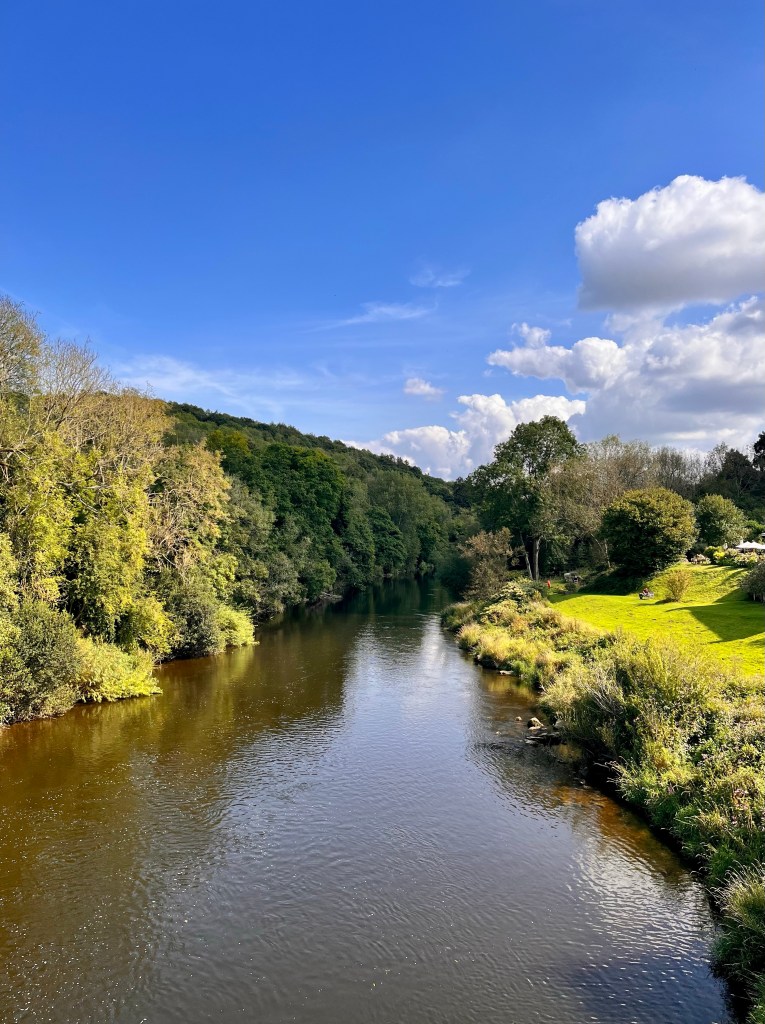
Its source is a peat landscape on Pumlumon (English Plynlimon) – the highest point of mid-Wales, starting life just outside the boundary of the Hafren Forest, summer lands of returning ospreys. Flowing down the landscape, the river begins to build power as it passes through the wonderfully named, Severn-Break-Its-Neck waterfall.
Apart from rain that falls on the Birmingham Plateau in the far North East, all rains that fall on Worcestershire drain into the river, which also draws on the Stour, the Avon and the Teme, before swelling to become five miles wide at the mouth of the Bristol Channel.
The river has its own lore. The name itself has ancient roots. The Welsh name ‘Hafren’ was said to be translated into Latin as ‘Sabrina’, and recorded in usage from the second century AD. Over time this name is said by some to have evolved through old English, ‘Sabern’ to the word Severn.
If you leave the cathedral via the cloisters on its south side and walk towards College Green, you will see a pathway and steps on the right that lead you down to the riverside, follow this and you will pass through the cathedral’s Grade II listed fourteenth century water gate.
“I am haunted by waters.”
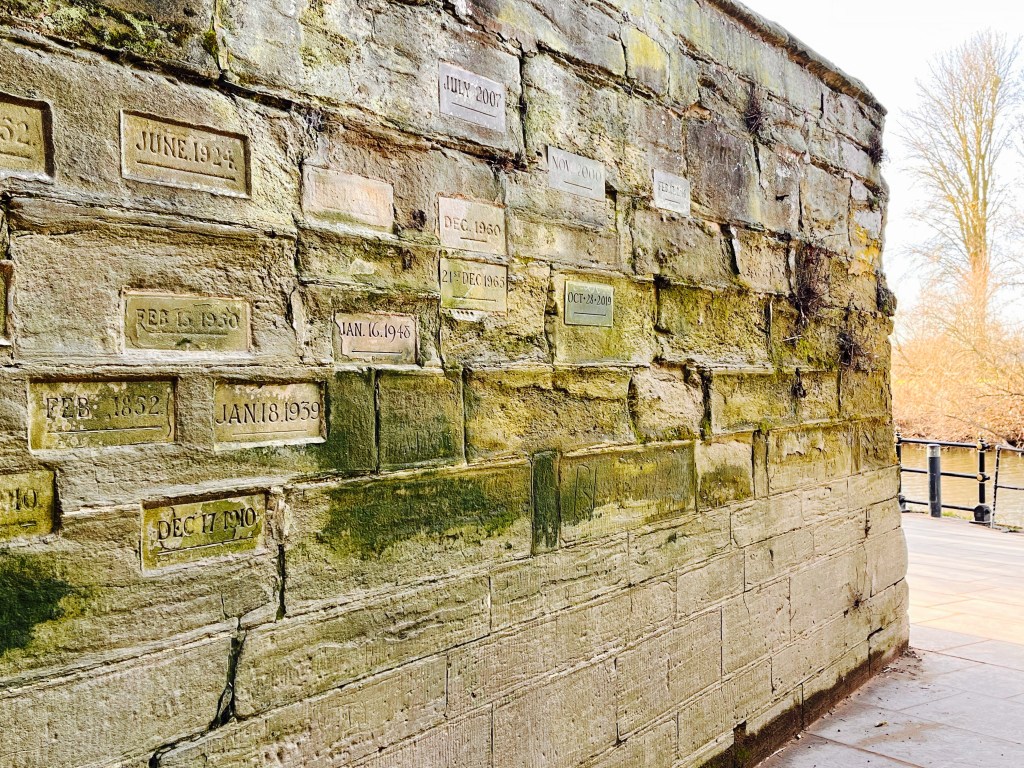
This line from, ‘A River Runs Through It’ by Norman Maclean is an apt description perhaps, of the old sandstone wall that you see on your left as you walk down through the gate house.
The wall is covered in markings, recording the high lines of water heights over years of repeated floods. Bricks that date back to 1672, “the stories of how this mighty river is both the life blood of the city and the key to its undoing” according to the Royal Geographic Society.
The medieval gate was built at a time when this part of the river would flood naturally with the tide in the days before Diglis Lock was built to the city’s south.
It also marks the line of sanctuary of the cathedral – the Severn could have delivered you straight to safety and protection.
When the river was at high tide, goods could have been directly landed in a small dock. There was also a river ferry in operation from the twelfth century, whereby a boatman would have been stationed at the gate to serve the priory (the predecessor of the cathedral) and those who lived within the monastic precinct, helping those that tended the priory’s cattle on the pastures that lay across the other side of the river at the Priory of Hardwick St John’s.
The cathedral library also has documentary evidence that the monks once had a Severn going ship, active from the middle of the fourteenth century and run by five or six crew.
Origins – Ancient Roots and Old Stones

Ute Engel writes at the beginning of her landmark architectural history, that Worcester Cathedral was built in ‘four stages over four centuries’, beginning with the Anglo-Norman Cathedral in 1084 and ending with the completion of the late Gothic nave of 1330 with the church being, “a medieval monument surviving mainly in its original form.”
The present cathedral sits on an ancient site, close to where a Roman ford once crossed the water – a city born from the river. It was the Severn that delivered the means to create the church here, bringing the building blocks of local sandstone, floated down from the nearby quarries up-river from Worcester – some via the cathedral’s own ship.
The See or Bishopric of Worcestershire dates back to the seventh century. The then Archbishop of Canterbury had been concerned by the size and power wielded by the Bishop of Lichfield and his immense Mercian See – covering a vast swathe of Anglo-Saxon England – thereby creating the Worcester and Hereford Sees.
Benedictine monks had arrived in Worcester under Bishop Oswald (962- 992) from around 970AD, building the early Anglo-Saxon cathedral of St. Mary on the site of an earlier monastic community of the priory of St. Peter. No firm archaeological evidence for these earlier buildings exists at the time of writing (but investigations are underway and more will surely follow).
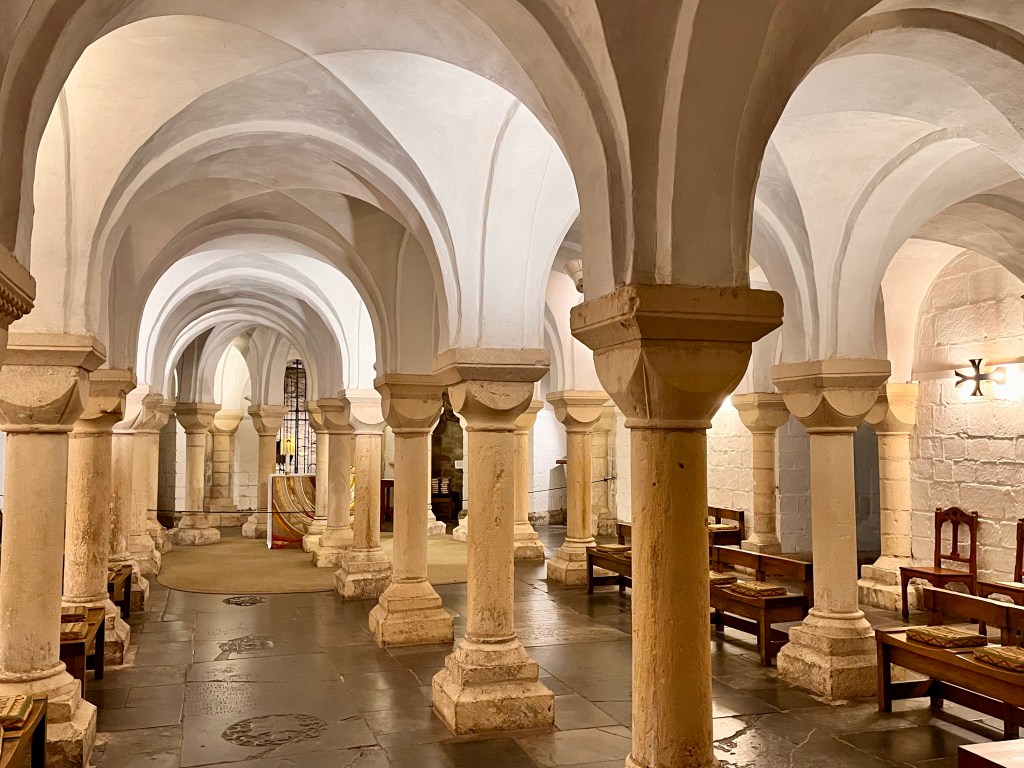
It was in 1084 under Bishop Wulfstan (1062-1095), that work to build the Norman cathedral started. Worcester’s beautiful crypt is the largest surviving part of Wulfstan’s Romanesque church.
By 1218, work was largely complete.
Over time, the building was altered and renewed in the Gothic style, with King Henry III bequeathing considerable materials to aid its renewal, including what would amount to a small forest of oak trees for the church that held the tomb of his father, King John.
Engel writes that the rebuilding work was partly spurred by the Bishop of Worcester’s desire to ensure that the cathedral retained the required level of grandeur befitting royalty and that it was likely, that the Bishop and not King Henry paid for John’s tomb.
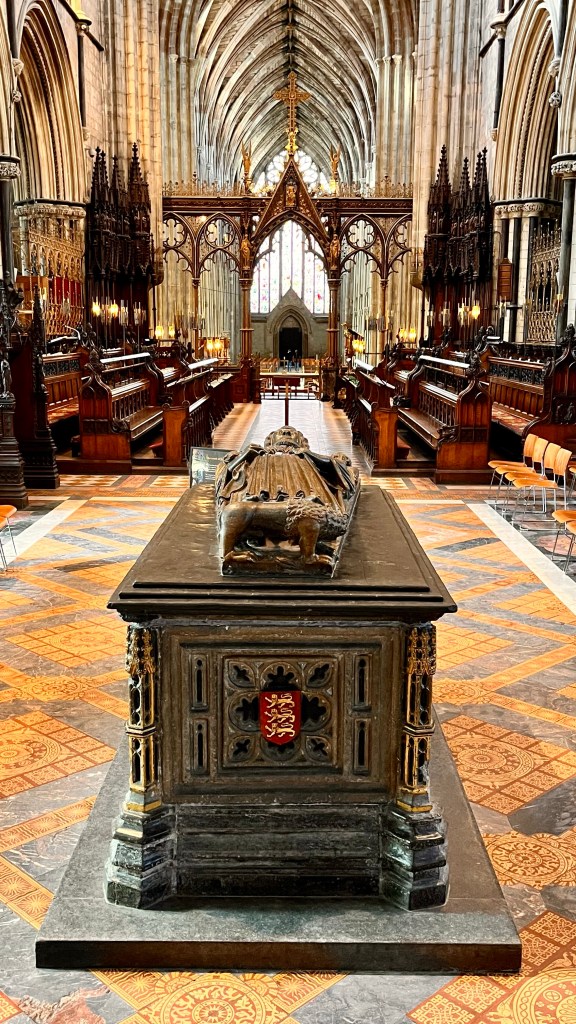
The construction in 1504 of the chantry chapel for Prince Arthur, eldest son of Henry VII who died at Ludlow Castle in 1502, was the last major work undertaken in the church before the world changed.
Reformation, Revolution, Restoration
The politics and seismic changes of the sixteenth and seventeenth century were to have to a great impact on the internal fabric and day to day life of this ancient building, changes that were to leave it in need of significant care and dedicated restoration.
In the mid-sixteenth century, the Reformation swept through England as Henry VIII famously broke with Rome in the stormy wake of his divorce from Catherine of Aragon.
The Church of England was born.
The effect of the Reformation on religious buildings and life in the country was widespread and devastating. Worcester and its cathedral were to be no exception as reformers sought to rid England of ‘superstitious’ religious practices.
The first to suffer were the cathedral’s famous shrines and tombs of bishops St Oswald and St Wulfstan, dismantled in 1538 at the eager behest of Hugh Latimer, the new Protestant Bishop of Worcester, who famously despised ‘idolatry’, the worship of saints and pilgrimages. The bones of the saints were encased in lead and buried somewhere in the Lady Chapel, exactly where is unknown.
The lost saints of Worcester.
Historians of the cathedral are unsure as to where the shrines stood or their exact appearance.
The antiquarian Valentine Green wrote in the eighteenth century how Bishop Wulfstans’ shrine was reported to have worked miracles in the early thirteenth century and that, “fifteen or sixteen persons within a day were said to have been cured from their diseases.”
King John’s burial in Worcester Cathedral is very likely connected to his wish to be near these famous shrines – saintly protection for eternity. The heads of the saints are depicted on John’s tomb and rather miraculously were not defaced during the Reformation. Recently, I asked the historian Professor David Carpenter about the style of the tomb at a talk he was giving about Henry III, and he confirmed he thought the design of John’s tomb was incredibly unique.

King Edward I was also apparently much taken with St Wulfstan’s shrine, often visiting the church, sending ornaments and candles to be burned at its base.
The shrines were said to be decorated with candelabras, precious stones and a large crucifix with painted images with separate head shrines kept in reliquaries. The cathedral library has records of offerings made at the separate head shrines, dating back to the early sixteenth century.
By 1540, the Priory of Worcester had been disbanded. After centuries, the monks and their ancient rituals were gone.
What followed was the further slow but systematic removal of objects of ‘superstition’ and the ‘old’ religion. The cathedral had at least 28 separate altars dedicated to a range of saints, including St John. They were all destroyed, changing the inner fabric of the church that had existed for centuries.
Green lists some of the changes made as a result of the great religious shift:
- 1547. The great brass candlestick, and the beam of timber before the high altar, were taken down. All the images on the high altar, and throughout the church, and all the other churches (of Worcester) were destroyed.
- 1548. The cup, with the body of Christ, removed from the high altar of St. Mary’s church, (the cathedral) and from other churches and chapels.
- 1550. King Edward VI commanded that all altars, crucifixes, and rood sellers should be pulled down, and to have long tables of wood, and there upon mass said in English.
- 1551. The high altar was demolished.
- 1560. The cross and image of ‘our Lady’ were burnt in the churchyard, after being previously stripped of its ornaments including its clothing and jewels.
The figure of the Virgin Mary known as ‘Our Lady of Worcester’, had long stood in the Lady Chapel surrounded by ever burning candles, drawing pilgrims for centuries. In ‘Spirits of Severn’, Michael Dames writes, that Latimer, originally wanted this ten foot statue of Mary taken by boat down the River Severn via the water gate, then on to public burning in London via the Thames. A sight which is quite something to imagine.

In a curious historical twist, Latimer was to meet a similar fate. The man who had wanted Worcester’s Mary burned, was himself burned at the stake in 1555 by Mary I, the Queen forever known as ‘Bloody Mary,’ as Catholicism was restored to England by Catherine of Aragon’s devout daughter.
By 1559, the old religion had, in Green’s words, “disappeared like a vapour from before men’s eyes,” with the, “glories of its splendid altars faded away.”
Civil War at the Door
Worcester was intensely affected by the English Civil War of 1642 to 1651. The ‘faithful city’ – a renowned royalist stronghold – was at the eye of the storm and was described by Arthur Mee, as ” the first city to rally to the king in the war,” and the, ”last city to stand by his son.“
The cathedral was at the heart of that last ‘Battle of Worcester’ which took place in 1651, its solid walls providing shelter for soldiers, prisoners, horses and weaponry.
The damage to the building was vast.
Parliament even agreed to pay for the clean-up, such was the building’s state and stench following the war. The physical toll on the building was high, with the lead roof removed for weaponry, likely, cannon balls. The walls, glass and fixtures deliberately vandalised by the winning parliamentarian forces, filled with puritanical zeal and hatred for the ‘high church’ and its images and symbols. This is when lime whitewash was thrown to desecrate the paintings on the medieval walls – gone in an instant.
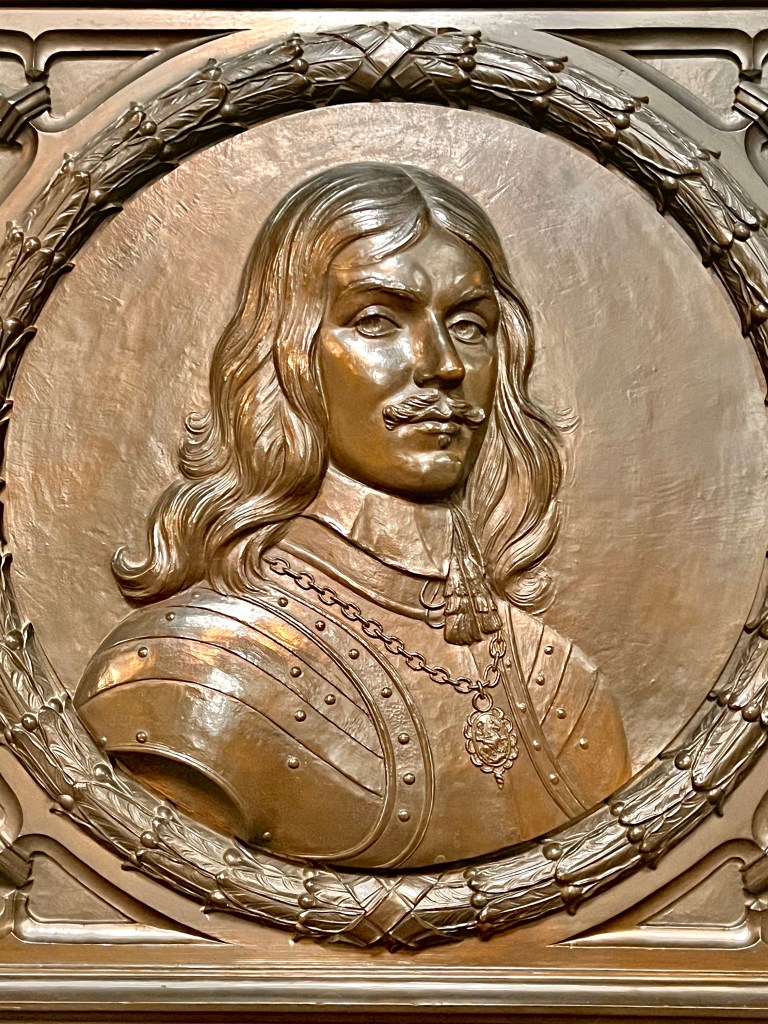
The cathedral retains a key memorial of the city’s royalist days. The 2nd Duke of Hamilton, who led the King’s last charge at the Battle of Worcester is buried under the High Altar. Whilst, in the cloisters there is the, ‘God Save our King’ cathedral treble bell of 1641, cast for Charles I in Walsall – how this bell survived the aftermath of the Civil war and the years of Cromwell’s Protectorate is remarkable.
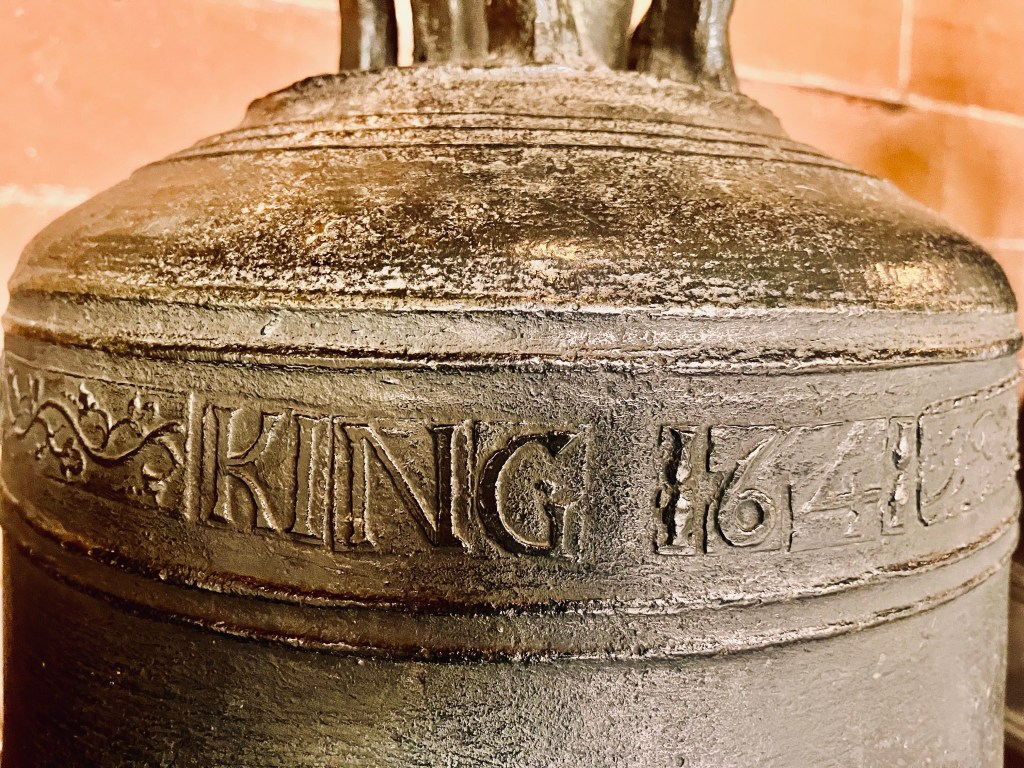
After the war, those left homeless and destitute by the destruction of city dwellings continued to live within the cathedral and its walls.
Following the restoration of the monarchy under Charles II in 1660, the slow painful process to restore the cathedral began, the building described as being in, “a lamentable state.”
It’s probably not an exaggeration to say that that at this point in its long history, Worcester Cathedral could have been lost.
The efforts of the clergy and local benefactors were to save it.
Restoration
Since the end of the Civil War, the cathedral has seen a number of restoration campaigns.
Two significant periods of repair were undertaken during the eighteenth century, with the roof, floors and the external sandstone walls in a poor condition. However, this repair work was not to be long lasting and by the 1850s the cathedral was once again in a terrible state. The external walls were crumbling, rain was getting through and the church’s vast nave, was said to be leaning outwards.
Once again the church was truly a building at risk with the weather taking a terrible toll, the soft red sandstone no match for centuries of English wind and rain whipping along the Severn and across from the Malvern Hills.
Today, the external and some of the internal look of Worcester is largely due to the ‘great restoration campaign’ of 1854-1874, led by the cathedral’s architect, Abraham Perkins and continued by that famous champion of the English Gothic Revival, Sir George Gilbert Scott. A restoration that received significant funding from the Earl of Dudley.
Perkins’ vision was bold, opting for reconstruction – much of the eighteenth century restoration including defective flying buttresses that propped up the walls were re-done. The entire exterior of the cathedral was re-faced with sandstone from nearby Ombersley, in some areas the building was given new foundations.
Perhaps Perkins thought this was ‘do or die’ for the building.
Gilbert Scott was later responsible for key elements of the interior redesign, including work to the cathedral choir, preserving Worcester’s incredible medieval misericords, as well as adding the open Gothic revival screen in 1873. Scott also designed the great west window, “a masterpiece of neo-medievalism” according to the writer Simon Jenkins, crafted in 1875 with glass by Hardman of Birmingham.
Views, critics, friends


Cathedrals of course have their reviewers, assessors and critics.
For Valentine Green writing in the late eighteenth century, the cathedral had, “a justness and symmetry”, creating a “most pleasing sense of awe.”
In 1926, the Great Western Railway’s guide to Cathedrals argued that these great buildings should not be compared but instead judged for their own beauty and contribution to history and art, and that, “Worcester Cathedral is rich in all these respects.”
For Arthur Mee, writing in his Worcestershire guide in 1948, the church, “stands in splendour with the Severn flowing past” with, “a dignity of its own.” He describes how walking into the cathedral makes him feel as if, “we are in the presence of the ages,” and that, “there in his tomb, lies the man who stamped and raged at Runnymede as he sealed the charter of our liberty; that there, in his most lovely little house, rests that Prince Arthur … whose death changed the face of the world.”
In 1968, Nikolaus Pevsner was in the city, considering the cathedral as part of his meticulous county architectural guides, famously designed to catalogue every notable building in England.

“Worcester Cathedral from the West, looking across the Severn, is a superb sight.”
Pevsner was clearly moved by that well-known western view – the river’s face. The same view that famously made its way onto the Edward Elgar Twenty Pound Sterling Banknote in circulation from 1999 until 2010.
Pevsner, along with other critics, was of course firmly in the business of judging cathedrals on their respective architectural merits.
Direct as ever and snippy at times, he would go on to complain about the transport planning that had led to Worcester’s ring road passing so close to the church as, “Looking from the East is out of the question now that the new road and the roundabout has removed all peace.”
The writer and critic, Simon Jenkins took this up a notch, writing in 2016, that, “There are two Worcesters, one in heaven and the other hell,” and that, “Heaven sits on a mound overlooking the River Severn, where its tower and west gaze towards Wales over the loveliest of cricket fields” but, “Hell arrived in the 1960s,” when the city ring road was built to the church’s north.
As for the building’s exterior, the GWR guide refers to Worcester’s external weathered stonework as, “ a Joseph’s coat of many colours,’ whilst Pevsner described the nineteenth century restored exterior of the building as a “disappointment, at least for the historian.”

The architectural historian Engel writing in her architectural study of the building, had a more circumspect view. Weighing up the challenges that the restorers faced due to the level of decay that was prevalent, she argued that the nineteenth century restorers had scruple and that the Victorian restoration stayed true to what remained of the original medieval form of the cathedral.
Whilst for Jenkins, the Victorian restoration makes Worcester, “hard to assess.”
Alec Clifton-Taylor writing in 1967, also had some sympathetic words for the Victorian restorers (though not for Scott’s screen and floor tiles!) who, “in many respects we owe a great debt too,” but he is also challenged where he thinks the restorers went too far. He writes however that Worcester’s choir is, “the leading example of the mature Early English style of architecture in the West of England,” an example that breathes “self-assurance, in the triforium to the point of virtuosity.”
Back with Pevsner, he was charmed when he ventured inside as, “the great asset of Worcester is the unity of its interior,” following in the footsteps of Mee who also claimed, “we are thrilled as we step inside this great place by the unbroken vista of its high vaulted roof.”
For Pevsner, the chancel is Worcester’s high point architecturally, describing the Lady Chapel as, “most thrilling” with an “irresistible excelsior”, whilst, also being rather blown away to find Norman niches in the Nave completely, “unique in England.”
He moves on to the Norman round shaped Chapter House that, “started a style of chapter houses entirely confined to Britain.” Worcester was the first of its kind.
The crypt is also singled out as, “early Norman work at its most impressive.”
For Christopher Somerville writing about the cathedral much more recently in 2019, “The architecture is remarkable, every kind of Norman and Gothic variation from Bishops Wulfstan’s plain and deep sunk walls to the beautiful and intricate Chantry Chapel of Prince Arthur.”
It is of course interesting to read the reviews of those whose business it is to critique architecture with trained eyes.
Like many others, I am eternally grateful first and foremost, that this great church and others of its kind have survived the challenges of the ages – whether be it political, polemical, through neglect or the good old English weather.
Ours and other great cathedrals survive preserving stories of resilience and steadfastness in their stones – offering us a form of security.
For Worcester, time hasn’t stood still and the building has moved along with us.
It is now the product of many designers, many architects and many master stonemasons, from the skill of the Victorian Hardman’s wonder of glass that is the west window, to the medieval carpenters who carved Worcester’s priceless, fantastical and at times hilarious Misericords to the modern day apprentices restoring the pinnacles.
Walking around the building, I love the worn stones in the cloisters where the monks would wash and the large dusty cobwebs that hang in the cool corners or from the faces of faded sculptures.
I also appreciate much of the Victorian restoration. I’m a fan of Scott’s, especially his work in the choir – including his carved screen which I think frames the western view along the nave beautifully, to me a great example of Scott’s Gothic revival aesthetic. The original screen would have been stone and closed but this opens up the grandest of long views.
Worcester – the River’s Cathedral and the Severn that washes its banks, will be there to tell tales, long after we have gone. This church where part of the Anglo-Saxon Chronicle was written fills us with a sense of comfort in its continuity, its stalwart calm in the face of challenge and threat.
As that famous son of Worcester, Edward Elgar, one time Master of the King’s Music, said speaking to the Friends of Worcester Cathedral in the 1930s, “ Having spent my life… in the shadow of the cathedral, having been born close to it and having come back as a truant to die under its shadow, nothing would give me greater happiness than to know its future is assured.”
We have centuries of stonemasons – past and present to thank for that.
Worcester Cathedral, the survivor above the great river.
As an endnote, a translated Latin inscription that Valentine Green recounts was engraved on an old Worcester clock bell – so fitting for the tale of this old survivor.
“Men’s deaths I tell, By doleful knell
Lightning and thunder I break asunder.
On Sabbath, all to church I call.
The sleepy head I raise from bed.
The winds so fierce I do disperse,
Men’s cruel rage I do assuage.”
Those interested in supporting this building, please consider joining us and becoming a Friend of the Cathedral at www.friendsofworcestercathedral.org.uk
By Lisa R Marshall 2023
Bibliography
Worcester Cathedral Guide – Peter Atkinson and Chris Guy (Worcester Cathedral)
Severn Valley Stories – Wilfred Byford-Jones (Shropshire Star and Journal Limited) 1967
A History of Worcestershire – David Lloyd (Bath Press) 1993
Worcester Cathedral – An Architectural History – Ute Engel (Phillimore) 2000
The History and Antiquities of Worcester – Valentine Green ( 1797)
A River Runs through It and Other Stories – Norman Maclean (Chicago University Press) 1976
Royal Geographical Society – ‘Worcester’s Watermarks’ – DiscoveringBritain.org
Spirits of Severn – Michael Dames (Austin Macauley) 2019
The King’s England: Worcestershire – Arthur Mee (Hodder & Stoughton) 1948
To Catch a King – Charles Spencer (William Collins) 2017
Cathedrals- The Great Western Railway – Martin S Briggs ( Ballantyne Press) 1926
The Buildings of England :Worcestershire – Nikolaus Pevsner (Penguin) 1968
England’s Cathedrals- Simon Jenkins ( Little, Brown) 2016
The Cathedrals of England – Alec Clifton-Taylor ( Thames and Hudson) 1986
Ships of Heaven – Christopher Somerville (Penguin) 2019
 Tales from the Halfshire Hundred